
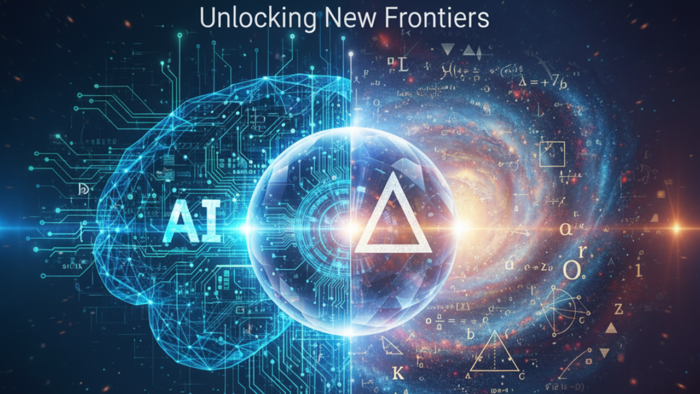
Artificial Intelligence (AI) has taken the world by storm — from self-driving cars to virtual assistants and predictive healthcare. But behind this intelligent revolution lies an ancient discipline that has quietly powered it all — Mathematics. The relationship between AI and Mathematics is not just deep; it’s indispensable. Every algorithm, every model, and every neural network owes its existence to mathematical logic, probability, and optimization.
In this detailed exploration, we’ll dive into how AI and Mathematics complement each other. From the basics of calculus and linear algebra to the sophisticated world of neural networks, we’ll understand how math gives AI its brain. We’ll also explore real-world applications, future directions, and why understanding this bond is key to becoming an AI innovator.
Understanding the Foundation of AI and Mathematics
The Symbiotic Relationship Between AI and Mathematics
AI is a mathematical system in disguise. Whether we’re teaching a machine to recognize images or generate text, it’s all about applying mathematical logic to data. Mathematics provides the framework for decision-making, learning, and generalization. Without it, AI would be nothing more than random guesses.
Mathematics turns data into insight. Concepts like probability, linear algebra, and statistics allow AI to identify patterns and make predictions. It’s this partnership between AI and Mathematics that creates the magic we see in technologies like ChatGPT, recommendation systems, and self-learning robots.
Why Mathematics Is the Language of AI
Mathematics offers precision, structure, and scalability — the three pillars of artificial intelligence. When machines learn, they’re essentially adjusting mathematical parameters to minimize errors. From gradient descent to backpropagation, math dictates how AI improves itself.
If programming is the “voice” of AI, then mathematics is its “mind.” It enables algorithms to think logically, adapt dynamically, and perform intelligently.
Core Mathematical Concepts Driving Artificial Intelligence
Linear Algebra – The Skeleton of AI
Linear algebra forms the foundation of every AI system. Vectors, matrices, and tensors are used to represent data and perform operations efficiently. Neural networks use matrix multiplications to propagate inputs and generate predictions.
In essence, every image, video, or text input processed by AI is converted into a matrix. This mathematical representation allows machines to handle massive datasets with speed and precision.
Calculus – The Engine Behind Learning
Calculus, especially differential calculus, drives how AI learns. In deep learning, algorithms adjust their parameters based on gradients — the rate of change in errors. This process, called optimization, is pure calculus at work.
When an AI model “learns,” it’s using calculus to minimize loss functions and improve accuracy. Without calculus, training an AI model would be like navigating a maze blindfolded.
Probability and Statistics – The Soul of AI Intelligence
Probability Theory in AI Decision-Making
Probability gives AI the power of reasoning under uncertainty. It helps models evaluate outcomes and make informed predictions. Bayesian networks, for instance, are rooted in probability theory and help AI systems make decisions even with incomplete data.
From weather forecasts to stock predictions, probability helps machines estimate outcomes that humans might struggle with. It’s where AI and Mathematics merge to simulate human-like thinking.
Statistics for Model Evaluation
Statistics allows AI developers to measure accuracy, precision, recall, and other performance metrics. It helps determine whether a model is truly intelligent or just overfitted to data.
Statistical methods also help interpret AI’s behavior — making results more explainable and trustworthy, which is crucial for real-world deployment.
Keypoint 1: AI without Mathematics is imagination without foundation. Every intelligent decision made by machines is backed by equations and logic.
Optimization – The Mathematical Heart of Machine Learning
Optimization Problems in AI
Optimization lies at the heart of machine learning. It ensures that AI systems perform efficiently and effectively. The goal of every algorithm is to find the best solution — whether it’s minimizing cost or maximizing accuracy.
For instance, gradient descent is an optimization method that iteratively improves AI performance by adjusting weights. This mathematical process transforms data into intelligence.
Convex vs. Non-Convex Optimization
Convex optimization ensures global minima — a guaranteed best solution. However, AI often deals with non-convex problems, where there are multiple local minima. Understanding the difference allows developers to design smarter algorithms.
This branch of mathematics helps AI handle complex, multidimensional problems, enabling deep learning architectures to function smoothly.
The Role of Discrete Mathematics in AI and Algorithms
Graph Theory in Artificial Intelligence
Graph theory plays a crucial role in AI — from social network analysis to natural language processing. It helps represent relationships between data points using nodes and edges.
Recommendation systems on Netflix or YouTube use graph-based algorithms to suggest content. Discrete mathematics provides the logic behind these systems.
Boolean Algebra and Logic in AI
Boolean algebra forms the foundation of computer logic and decision-making. It helps AI systems make binary decisions — true or false, yes or no. This logic drives everything from digital circuits to expert systems.
When combined with fuzzy logic, Boolean algebra allows AI to deal with uncertainty — an essential component of real-world intelligence.
Geometry and Topology in AI Models
Geometric Representations in Machine Learning
AI models often interpret data geometrically. For example, word embeddings in NLP represent meanings as points in multidimensional space. Distance between points determines similarity — a geometric concept.
By understanding geometric transformations, AI can identify relationships between objects, words, and images.
Topology and Data Manifolds
Topology helps AI visualize how data points are distributed across high-dimensional spaces. This allows algorithms to “see” patterns that are invisible to humans.
Manifold learning, a technique inspired by topology, helps AI reduce complex datasets into simpler representations — making deep learning more efficient.
Keypoint 2: From linear algebra to topology, every layer of AI’s intelligence is built on mathematical reasoning. Without math, AI would be chaos without comprehension.
Numerical Methods – The Hidden Computation Power Behind AI
The Importance of Numerical Accuracy in AI
In artificial intelligence, especially when dealing with large-scale datasets, numerical precision determines success or failure. Numerical methods help approximate solutions to mathematical problems that can’t be solved analytically.
When an AI model performs matrix multiplications or solves optimization problems, it relies on numerical stability to ensure reliable results. Floating-point arithmetic, interpolation, and iterative algorithms play vital roles here.
Without the mathematical rigor of numerical methods, AI computations would suffer from rounding errors, divergence, or instability. Hence, numerical mathematics ensures the consistency and accuracy of AI’s computational backbone.
Iterative Solvers and Convergence
Iterative solvers like gradient descent or conjugate gradient methods are the bread and butter of machine learning optimization. These algorithms iteratively adjust model parameters until convergence is achieved.
The mathematics behind convergence — step sizes, learning rates, and tolerance limits — ensures that AI models don’t diverge or get stuck in infinite loops.
Thus, the success of every AI training cycle rests on the mathematical discipline of numerical analysis.
Information Theory – The Mathematics of Knowledge in AI
Entropy and Information Gain
Information theory, pioneered by Claude Shannon, quantifies information using mathematics. In AI, the concept of entropy measures uncertainty, while information gain quantifies how much new knowledge is obtained from data.
Decision trees, for example, use entropy to split nodes optimally — selecting the feature that offers the highest information gain.
This mathematical understanding helps AI compress data, remove redundancy, and extract meaningful signals from noise.
Mutual Information and Deep Learning
Mutual information measures dependency between variables. Deep learning models, particularly autoencoders, use this concept to ensure latent representations preserve maximum information.
By mathematically encoding information flow, AI systems can reduce overfitting and improve generalization — crucial for robust performance.
Neural Networks – Mathematics in Motion
Matrix Operations in Neural Networks
Every neuron in a network performs matrix multiplications to process inputs. The weights and biases — key parameters of AI — are elements of these matrices.
Through linear algebra and calculus, these networks compute activations and adjust connections using backpropagation.
Hence, neural networks are essentially mathematical graphs — dynamic systems that evolve through thousands of matrix-based computations.
Activation Functions and Nonlinear Transformations
Mathematical functions like sigmoid, tanh, and ReLU introduce non-linearity into neural networks. This allows AI systems to handle complex, real-world data.
Each activation function is derived from mathematical principles that balance smoothness, differentiability, and computational efficiency.
Mathematics ensures that AI transitions from simple pattern recognition to intelligent problem-solving.
Keypoint 3: Every neuron, activation, and connection in an AI model is powered by mathematical logic. The smarter the AI, the deeper its mathematical core.
Differential Equations – Modeling Intelligence Dynamically
Ordinary Differential Equations (ODEs) in AI Models
Differential equations describe change — the essence of learning. Neural ODEs (Ordinary Differential Equations) treat deep learning as a continuous process rather than discrete layers.
This mathematical modeling allows AI to understand dynamic systems like fluid flows, population growth, and temporal forecasting.
By solving ODEs numerically, AI can simulate real-world processes with remarkable precision.
Partial Differential Equations (PDEs) and Spatial Data
PDEs are vital in modeling multidimensional changes, especially in image processing and computer vision. Convolutional neural networks (CNNs) mimic PDE-like operations, capturing edges and patterns.
The blend of PDE mathematics and AI enables machines to perceive spatial relationships — a foundation of computer vision and 3D modeling.
Bayesian Inference – The Mathematical Mind of Probabilistic AI
Bayes’ Theorem and Belief Updating
At the heart of probabilistic AI lies Bayes’ theorem — a formula that updates beliefs based on evidence.
For example, a spam filter uses Bayesian logic to determine the probability that an email is spam given certain keywords.
Bayesian reasoning ensures that AI systems don’t just make predictions — they continuously improve them as more data arrives.
Bayesian Networks and AI Decision Graphs
Bayesian networks represent variables and dependencies graphically. They help AI handle uncertainty and causal relationships effectively.
These mathematical models are extensively used in diagnostics, recommendation systems, and risk assessment — offering interpretability alongside prediction.
Data Science – The Meeting Ground of AI and Mathematics
Statistical Data Modeling
Data science acts as a bridge between mathematics and AI. It uses statistical tools to extract meaningful insights and prepare data for AI models.
Techniques like regression, hypothesis testing, and principal component analysis (PCA) come directly from mathematics and are used to preprocess and visualize data.
Without mathematical preprocessing, AI models would struggle to interpret noisy, unstructured data.
Machine Learning Pipelines and Quantitative Analysis
Mathematics ensures each stage of the machine learning pipeline — from feature selection to evaluation — is analytically sound.
Quantitative measures like variance, covariance, and correlation drive data-driven decisions, reinforcing the scientific foundation of AI development.
Applications of AI and Mathematics in Real Life
AI in Healthcare and Predictive Diagnosis
In healthcare, AI and Mathematics combine to predict diseases, identify patterns in medical images, and optimize treatments. Mathematical modeling of biological systems allows AI to simulate disease progression and suggest interventions.
Statistical inference and probability make these predictions reliable and explainable.
AI in Finance and Risk Analysis
Financial modeling is built on mathematics — and AI makes it smarter. Using mathematical optimization, AI can analyze market trends, detect fraud, and automate trading strategies.
Techniques like regression analysis, time series forecasting, and stochastic calculus form the quantitative core of financial AI systems.
Keypoint 4: Mathematics turns AI from a tool into a thinker. Every real-world success story of AI is a victory for applied mathematics.
Mathematical Logic and Ethical AI
Logic and Reasoning in Artificial Intelligence
At the philosophical and computational core of AI lies mathematical logic. Propositional and predicate logic allow AI systems to reason systematically, evaluate conditions, and make deductions.
When an AI chatbot answers questions or a self-driving car decides whether to stop, it’s executing logic-based reasoning derived from mathematical rules.
The discipline of symbolic logic ensures that AI decisions are not random but consistent and explainable. This is why logical reasoning is fundamental to ethical AI behavior.
The Role of Mathematics in AI Ethics
Ethical AI demands fairness, transparency, and accountability — all quantifiable through mathematics. For example, fairness metrics like demographic parity or equal opportunity are defined mathematically.
AI engineers use these mathematical definitions to reduce bias and enhance transparency in algorithms. Thus, AI and Mathematics unite not just in technology but also in moral reasoning.
AI and Mathematics in Education
Transforming Mathematics Learning through AI
AI-driven tools are revolutionizing math education. Intelligent tutoring systems use adaptive algorithms to understand a student’s learning pattern and offer personalized exercises.
Machine learning models analyze errors and provide step-by-step guidance. This union of AI and Mathematics transforms passive learning into interactive exploration.
Using Mathematics to Build Smarter Educational AI
Conversely, mathematics helps build better AI tutors. Algorithms that optimize learning schedules or problem selection rely on statistical models, reinforcement learning, and optimization equations.
This synergy between AI and Mathematics in education ensures both teaching and technology evolve hand in hand.
Computational Geometry – Visualizing Intelligence Mathematically
Geometry in Computer Vision
AI’s ability to perceive the world visually depends heavily on geometry. Techniques like object detection, edge recognition, and shape matching are grounded in geometric transformations.
When an AI recognizes a face, it’s performing mathematical computations on geometric patterns in pixel space.
Geometry in Robotics and Navigation
In robotics, geometric algorithms are used to map environments, plan paths, and avoid obstacles. These calculations depend on coordinate geometry, trigonometry, and vector calculus.
Computational geometry ensures that robots move intelligently, safely, and efficiently — a true display of AI and Mathematics working in perfect harmony.
Keypoint 5: AI sees the world mathematically. From pixels to probabilities, geometry to logic — every layer of intelligence begins with numbers.
Advanced Mathematical Models in AI
Tensor Calculus and Deep Learning
Tensor calculus extends linear algebra to higher dimensions, allowing neural networks to model complex relationships. Frameworks like TensorFlow are named after these mathematical structures.
By manipulating tensors, AI systems process large-scale data efficiently, enabling breakthroughs in image recognition and natural language processing.
Nonlinear Dynamics and Chaos in AI
Some AI systems are inspired by chaos theory — the study of dynamic, unpredictable systems. Nonlinear mathematics helps AI model real-world unpredictability, such as weather systems or financial markets.
This adaptability allows AI to navigate complex environments without collapsing into error.
Mathematical Modeling in Predictive AI
Regression and Forecasting
Predictive AI depends on regression models — linear, polynomial, and logistic. Each model is rooted in mathematical functions that relate inputs to outputs.
These equations help AI forecast sales, detect disease patterns, or predict climate changes with astonishing accuracy.
Time Series and Signal Processing
Mathematics powers temporal data analysis. Fourier transforms, wavelet analysis, and autoregressive models allow AI to understand signals over time.
This mathematical precision enables AI to detect fraud, forecast traffic, and even predict earthquakes.
Challenges in Integrating AI and Mathematics
The Complexity Barrier
While mathematics empowers AI, the complexity of certain models can become overwhelming. Solving non-convex optimization problems or dealing with high-dimensional data can lead to computational bottlenecks.
Balancing precision with practicality is one of the toughest challenges in the fusion of AI and Mathematics.
The Explainability Challenge
Mathematical models can be too abstract for human interpretation. Deep learning, though highly mathematical, often functions as a “black box.”
Researchers are working to create interpretable mathematical frameworks that explain how AI arrives at decisions — ensuring transparency and trust.
The Future of AI and Mathematics
Emerging Mathematical Frontiers
Future AI systems will rely on new branches of mathematics — such as category theory, quantum algebra, and topological data analysis. These advanced tools will help AI tackle problems beyond classical computation.
Quantum computing, for example, merges linear algebra and complex numbers to create next-generation intelligent systems.
Building the Mathematicians of Tomorrow’s AI
The future of AI and Mathematics depends on education. As the boundaries between disciplines blur, tomorrow’s innovators must be both data scientists and mathematicians.
By mastering mathematical reasoning, we empower AI to grow responsibly, efficiently, and intelligently.
🌟 Conclusion: AI and Mathematics — The Eternal Equation
Mathematics is the silent architect of AI’s intelligence. From the first line of code to the deepest neural network, math provides structure, precision, and adaptability.
Artificial intelligence, in turn, gives mathematics a living, evolving form — transforming static equations into learning entities.
Together, AI and Mathematics form an unbreakable bond — one that defines not only the future of technology but also the evolution of human thought itself.
10 FAQs on AI and Mathematics
1. What is the relationship between AI and Mathematics?
AI is fundamentally built on mathematical concepts like linear algebra, calculus, probability, and statistics, which help machines learn and make intelligent decisions.
2. Can AI exist without Mathematics?
No. Mathematics is the foundation of all AI algorithms. Without mathematical structures, AI would lack logic, structure, and learning capability.
3. How is linear algebra used in AI?
Linear algebra handles data representation and computation in AI models, especially in neural networks where matrices represent weights and activations.
4. What role does calculus play in AI?
Calculus enables optimization — helping AI minimize errors and learn effectively through gradient-based methods.
5. How does probability influence AI?
Probability allows AI systems to make predictions under uncertainty, driving models like Bayesian networks and decision trees.
6. Why is optimization important in AI?
Optimization ensures AI models perform efficiently by finding the best parameters that maximize accuracy or minimize cost.
7. Are there real-world examples of AI and Mathematics in action?
Yes. AI applications in finance, healthcare, robotics, and weather forecasting all rely on deep mathematical modeling.
8. How is AI changing mathematics education?
AI-based learning tools personalize mathematical education, making it adaptive and more interactive for students.
9. What are the biggest mathematical challenges in AI today?
Scalability, explainability, and computational efficiency remain major mathematical challenges in modern AI systems.
10. What is the future of AI and Mathematics?
The future lies in integrating advanced mathematical concepts like quantum theory, topology, and category theory to create even more intelligent systems.
**breathe**
breathe is a plant-powered tincture crafted to promote lung performance and enhance your breathing quality.
https://t.me/s/Top_BestCasino/140
Mathematics is the foundation of all AI algorithms. Without mathematical structures, AI would lack logic, structure, and learning capability.
Alright, 7e777game, you’ve got my attention. Let’s see if you can keep it. Exploring it now. Hoping for some epic gameplay! See what 7e777game is about 7e777game
Alright, so I peeped gàchoi c1.com. Take a look and holler if you find anything interesting!
So I stumbled upon game98win the other day. Pretty slick interface, I gotta say. Worth a look if you’re hunting for something new. You might just like it: game98win
I discovered your blog site on google and examine a few of your early posts. Continue to maintain up the very good operate. I simply further up your RSS feed to my MSN Information Reader. Seeking forward to reading extra from you later on!…
Boost your confidence with the Practitioner Practice Test. The Practitioner Practice Test helps you assess knowledge, identify weak areas, and improve skills. Preparing with the Practitioner Practice Test ensures success and mastery in your field through effective practice.
Your article helped me a lot, is there any more related content? Thanks! https://accounts.binance.info/en-IN/register-person?ref=A80YTPZ1
There is evidently a bunch to realize about this. I consider you made some nice points in features also.
This is the precise weblog for anyone who wants to find out about this topic. You realize so much its virtually onerous to argue with you (not that I truly would want…HaHa). You positively put a brand new spin on a topic thats been written about for years. Nice stuff, simply nice!
Your point of view caught my eye and was very interesting. Thanks. I have a question for you.
This is a topic close to my heart cheers, where are your contact details though?
I have been exploring for a little bit for any high-quality articles or blog posts on this sort of area . Exploring in Yahoo I at last stumbled upon this website. Reading this info So i’m happy to convey that I have a very good uncanny feeling I discovered exactly what I needed. I most certainly will make sure to don’t forget this site and give it a glance regularly.
I conceive other website proprietors should take this site as an model, very clean and good user genial design.
I don’t normally comment but I gotta say regards for the post on this perfect one : D.
I was reading some of your articles on this internet site and I believe this website is really instructive! Keep on posting.
Thanks for sharing. I read many of your blog posts, cool, your blog is very good.
**prostafense**
ProstAfense is a premium, doctor-crafted supplement formulated to maintain optimal prostate function, enhance urinary performance, and support overall male wellness.
**prodentim**
ProDentim is a distinctive oral-care formula that pairs targeted probiotics with plant-based ingredients to encourage strong teeth, comfortable gums, and reliably fresh breath.
The next time I read a blog, I hope that it doesnt disappoint me as much as this one. I mean, I know it was my choice to read, but I actually thought youd have something interesting to say. All I hear is a bunch of whining about something that you could fix if you werent too busy looking for attention.
Glad to be one of the visitants on this awing site : D.
Your point of view caught my eye and was very interesting. Thanks. I have a question for you. https://www.binance.info/bn/register-person?ref=WTOZ531Y